
On June 26, CECNY Land Holdings, LLC — the IHG-owned developer behind the proposed Six Senses Hudson Valley luxury resort — filed its THIRD Article 78 lawsuit in Dutchess County Supreme Court, this time seeking to overturn the Clinton Planning Board’s unanimous May 28 Positive Declaration and eliminate the requirement for a full Environmental Impact Statement (EIS). The filing arrived the same day the public scoping comment period closed. (See related post.)
The hypocrisy is hard to miss. Six Senses and its parent company IHG market themselves globally as champions of sustainability and ecological stewardship — yet here they are suing, fighting to deny the citizens of Clinton and Hyde Park the independent environmental review that New York State law provides them.
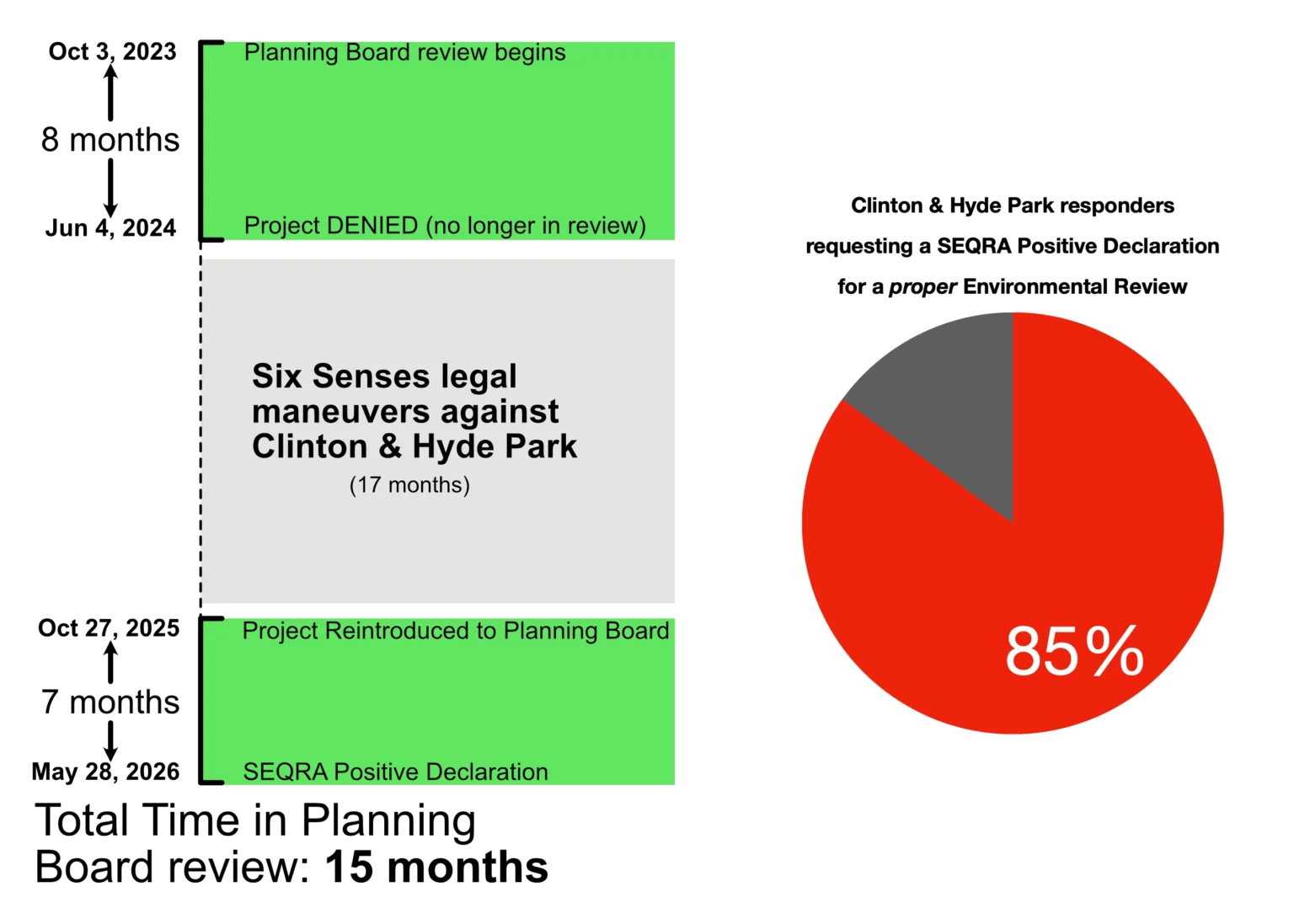
The developer’s timeline claim doesn’t hold up. The lawsuit complains of “three years of review.” In fact, their plan was introduced to the Planning Board on October 3, 2023, then denied by Clinton’s Zoning Board of Appeals on June 4, 2024. IHG’s legal team then pressured Hyde Park’s board to create and force through a new law specifically negotiated for Six Senses, overriding that denial. Clinton’s Town Board then signed onto a settlement, overriding their ZBA’s requirement for unappealable road access, before the project could be re-introduced. The threat of legal expenses were cited as the primary reasoning behind each settlement, rather than risk of losing in court. The project was reintroduced to the Planning Board on October 27, 2025. The Planning Board review up to the Positive Declaration May 28, 2026, has been fifteen months — not three years.
The community support numbers are fiction. The lawsuit claims 102 of 186 public comments favored a negative declaration. Those figures come from CECNY’s own post-deadline summary — one that excluded 200+ Clinton and Hyde Park residents who signed CSHV’s Positive Declaration petition, while counting form-letters organized by Six Senses affiliates and business associates from other towns. When CSHV compiled the full record and identified each commenter’s municipality, the real picture emerged: 85% of Clinton and Hyde Park residents — 155 of 183 — called for a Positive Declaration. Across all commenters including distant business interests, 67% supported a full EIS.
The lawsuit petition undermines itself. Even Chairman Thomas is quoted in the filing saying he wanted wastewater included in the EIS because “all this is connected” — a textbook rationale for comprehensive environmental review, not evidence of arbitrary decision-making. Board Member Auspitz argued for the EIS so the public could feel “everything that can be said and can be done IS done.” The developer calls this illegitimate. We call it exactly what SEQRA is designed to do, and our Planning Board following the law.
The EIS process must proceed. The residents of Clinton and Hyde Park deserve an honest, independent accounting of what this project would cost their land, water, roads, and community. That is what the developer is trying to take away — and we will not let that happen without a fight.
The developer behind the proposed Six Senses Hudson Valley luxury resort has initiated it’s THIRD lawsuit in Dutchess County Supreme Court, this time seeking to overturn the Clinton Planning Board’s unanimous May 28 Positive Declaration — a decision that triggered a formal Environmental Impact Statement (EIS) and the most thorough independent scrutiny the project had faced in 15 months of review.
The Article 78 petition, filed by CECNY Land Holdings, LLC (owned by Six Senses, part of IHG – InterContinental Hotel Group) on June 26, asks the Court to annul the Positive Declaration and eliminate the EIS requirement entirely, effectively returning the project to a rubber-stamp track. The timing is notable: the filing arrived the same day the public scoping comment period closed, with dozens of substantive submissions from scientists, environmental organizations, elected officials, and concerned residents calling for exactly the kind of rigorous review the developer now wants a court to prevent.
Six Senses markets itself globally as a pioneer of sustainability, ecological stewardship, and harmony with the natural world. Its parent company, IHG Hotels & Resorts, touts environmental responsibility as a core brand commitment.
And yet here, in Clinton, New York, the same developer is asking a court to deny the citizens of Clinton, Hyde Park, and Rhinebeck the benefit of a full, independent environmental analysis of a project that would introduce up to 240 guests at a time onto an agricultural property straddling two towns, discharge treated wastewater into Crum Elbow Creek, and operate at an intensity the area’s zoning was never designed to accommodate.
The contradiction could not be more stark: a resort that sells environmental consciousness as a luxury amenity is fighting in court to avoid the environmental accountability that ordinary New Yorkers are entitled to under state law.
The petition argues that the Planning Board’s Positive Declaration was “arbitrary and capricious” because it lacked sufficient written explanation for each area of concern — wastewater, ecological habitat, community character, and consistency with the Town’s Comprehensive Plan.
But read carefully, the petition undermines its own premise at nearly every turn.
On wastewater, the petition acknowledges that even the Board’s own Chairman, Paul Thomas, stated he wanted the issue included in the EIS — not because the system was deficient, but because “all this is connected.” That is precisely the kind of integrative, systems-level thinking an EIS is designed to support. The developer’s complaint that the Board wanted to look more closely is not evidence of arbitrariness; it is evidence that the Board was doing its job.
On community character, the petition quotes Board Member Auspitz arguing for the EIS because it would allow the public to feel that “everything that can be said and can be done is done.” The developer calls this illegitimate. We call it democracy. The Planning Board serves the residents of Clinton — not the shareholders of IHG.
On community plans, the petition boasts that the developer’s own consultant at NPV stated the project would have no significant adverse impact on community planning. Yet that same consultant was working for the Planning Board — paid for out of escrow funded by the developer. The Board was under no obligation to accept that conclusion, and it didn’t. That is exactly the kind of independent judgment SEQRA is designed to protect.
The petition leans heavily on the cost and duration of the review to date — noting that the applicant has submitted over 10,300 pages of materials and reimbursed the Planning Board more than $153,000 in consultant fees over three years. This is offered as evidence that further review is unnecessary.
But this framing is misleading in a critical respect.
The project was not before the Clinton Planning Board for three years. It began review by the Planning Board on October 3rd, 2023, then denied — on June 4, 2024 by the Zoning Board of Appeals. That denial was the Zoning Board of Appeals doing exactly what ZBA’s are supposed to do: saying no to a project that did not meet the community’s standards and laws.
What followed was not a straightforward resubmission. IHG and its legal team applied sustained pressure on small-town boards to create new laws that had the effect of overriding that appropriate denial. Only after those maneuvers succeeded was the project reintroduced to the Planning Board — on October 27, 2025. That means the current review had been underway for just fifteen months, not three years.
The “three years of review” the petition invokes includes the period before the project was denied, the denial itself, and the legal pressure campaign used to resurrect it. Counting that clock as continuous review is a sleight of hand. The Planning Board that issued the Positive Declaration in May 2026 had been living with this reintroduced application for fifteen months — not three years — before concluding that an EIS was warranted.
Volume is not the same as adequacy, and duration is not the same as thoroughness. The entire premise of SEQRA is that an independent environmental review — one not produced by or for the applicant — is necessary before significant development proceeds. The EIS process gives the public, the Board, and independent experts the opportunity to evaluate the developer’s claims on their merits, with full transparency. That the developer has spent considerable time and money making its case — and considerable legal effort keeping it alive — is not a reason to foreclose the public’s ability to examine it.
The petition makes much of the public comment record, claiming that 102 of 186 public comments supported a negative declaration — and that Board Member Ferrini found much of the opposition “unpersuasive” and “sometimes offensive.” Chairman Thomas is quoted agreeing with the positive comments for the project.
What the petition does not tell the Court — or the public — is that those numbers were produced by the developer itself, using a methodology carefully designed to favor that outcome.
After the SEQRA public comment deadline of March 27, 2026 at 5:00 p.m., CECNY and its representatives submitted thousands of additional pages to the Planning Board, including their own summary and tabulation of public feedback. That summary excluded more than 200 local residents who signed CSHV’s petition calling for a Positive Declaration — while simultaneously counting all form-letter submissions distributed by Six Senses and its allies. The summary also failed to identify the municipality of each commenter, making it impossible for the Board to distinguish a Clinton neighbor with firsthand environmental concerns from a Beacon real estate broker or a Rhinebeck Chamber of Commerce member with business ties to or interests in the development.
When CSHV compiled the complete public record — including public hearing speakers, personal letters, negative declaration form letters, and the CSHV Positive Declaration petition — and identified each respondent’s municipality using public records, the picture looked entirely different. Among residents of Clinton and Hyde Park, the two towns the Planning Board serves as SEQRA Lead Agency, an overwhelming 85% of respondents — 155 of 183 — requested a Positive Declaration. Across all commenters, 67% of the TOTAL public record — 208 of 309 — supported a full Environmental Impact Statement.
The developer’s numbers didn’t reflect community sentiment. They reflected the developer’s ability to organize form-letter campaigns among business allies, real estate associates, and affiliated organizations — while erasing the voices of the people who actually live where this project would be built.
That CECNY is now citing those same manipulated numbers in their lawsuit, as evidence that public opposition was negligible and the Planning Board was merely “appeasing” an unpersuasive minority, is not just misleading. It is an insult to every Clinton and Hyde Park resident who took the time to participate in good faith in the public process.
Read more about the misleading filing from our April 15, 2026 news:
Six Senses Misleads Planning Board…
Clinton’s current predicament did not arise by accident. In 2022, some members of Clinton government welcomed this project without full appreciation of what it would become. Once invited in, the development interests have proven difficult to negotiate — and they are now using the courts to extend that advantage.
CECNY Land Holdings (IHG/Six Senses) paid a price for this property that has been widely noted as a significant premium over its agricultural value. That premium only makes sense if the developer was confident — from the outset — that it could build something far larger than the property’s zoning or environmental capacity would ordinarily support. The lawsuit is not a good-faith challenge to a flawed process. It is an effort to protect that original investment by eliminating the one mechanism capable of revealing whether it was ever justified.
Common Senses Hudson Valley believes the Planning Board acted properly, courageously, and in full compliance with its legal obligations when it issued the Positive Declaration. The Board heard developer-produced information, considered extensive public comment, and concluded — unanimously — that further independent review was warranted. That conclusion is entitled to deference under well-established New York law.
We are confident the Court will agree.
In the meantime, the EIS process should proceed. The scoping record — now closed — contains some of the most substantive scientific and environmental analysis and concerns ever submitted in connection with a land use proceeding in this region. It deserves to be acted upon, not buried by litigation.
The residents of Clinton, Hyde Park, and Rhinebeck deserve an honest accounting of what this project would actually cost their land, their water, their roads, and their community. That is what an EIS provides. That is what the developer is trying to take away.
We will not let that happen without a fight.
without subscribing to our e-mails! We keep e-mails to a minimum, reaching out when there is new information or we need your activism.
(We DO NOT share your information with anyone else.)